
Elwood History Carnegie Library
Carnegie Library
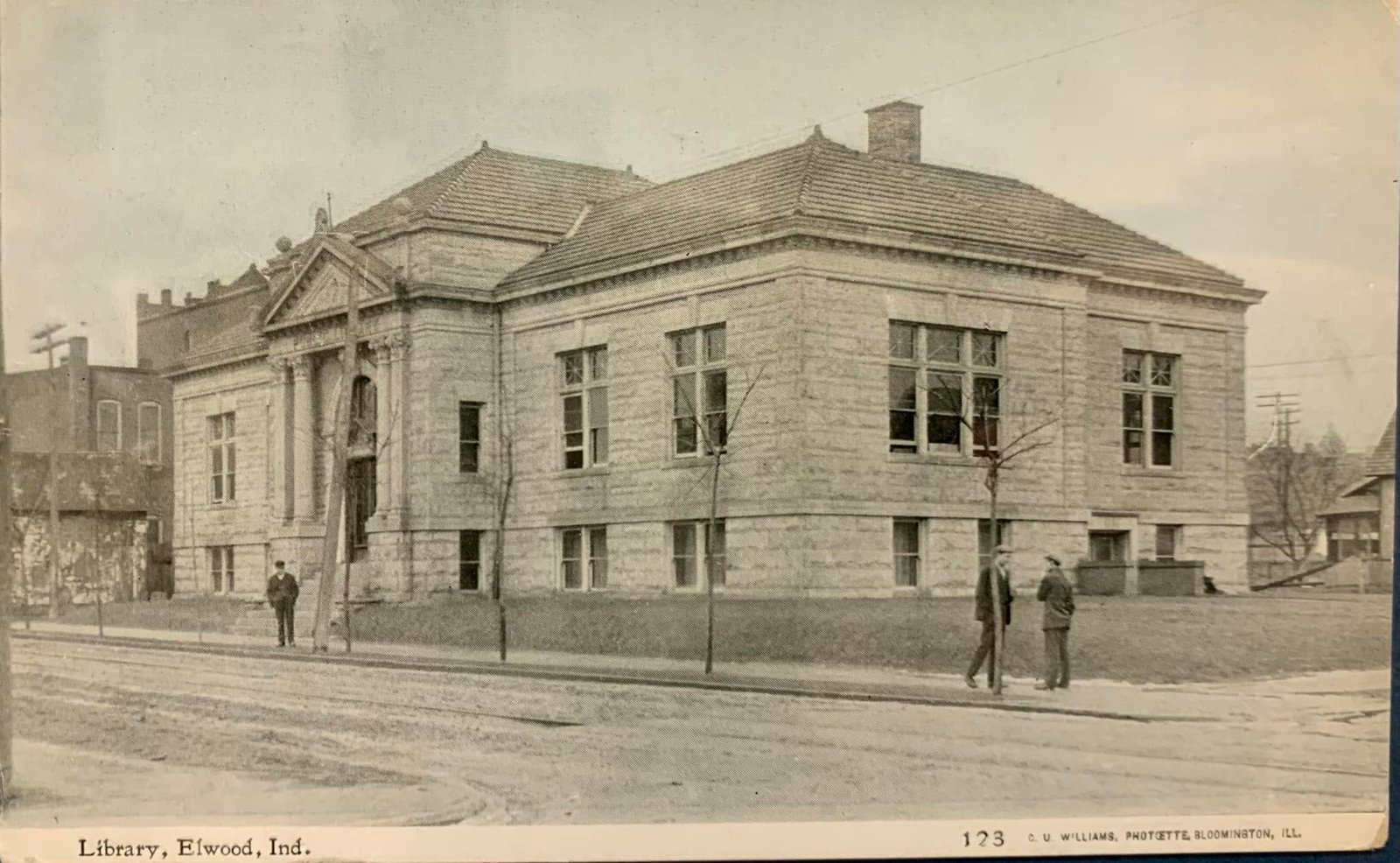
A Landmark of Knowledge, Community & Civic Life
Collection: Elwood, Indiana — Architectural & Civic History
Institution: Former Elwood Public Library
Address: 124 North 16th Street, Elwood, Indiana
Construction: 1903–1904
Dedication: June 1, 1904
Original Carnegie Grant: $25,000
Additional Carnegie Funding: $5,000
Total Carnegie Contribution: $30,000
Architectural Style: Neoclassical Revival
Original Function: Public Library and Community Cultural Center
Library Service: 1904–1997
Current Use: Historic adaptive-reuse event and gathering space
I. HISTORY
From a Small Subscription Library to a Carnegie Institution
The history of Elwood’s Carnegie Library begins not with the construction of the building, but with the determination of local citizens to establish a permanent center for education and culture.
In October 1898, a group of Elwood residents began organizing a public library. The effort emerged during a period of extraordinary growth for the community, when Elwood’s population and industrial base were expanding rapidly as a result of the natural-gas boom.
The organizers envisioned a library that would provide ordinary citizens with access to books, newspapers, educational materials and a place for intellectual and cultural development.
Fundraising followed. By early 1899, approximately $1,200 had been raised. A small storefront at 1414 Main Street was fitted out as the first library, and the collection was opened to the public in May 1899. The initial collection consisted of approximately 1,150 books and twelve magazines.
The experiment was an immediate success.
As Elwood grew, so did the library’s patronage and collection. The institution eventually moved into space within the newly constructed city hall, but even that larger location soon proved inadequate.
The Appeal to Carnegie
One of the most important figures in the library’s early history was Nellie B. Fatout, who became the library’s trained librarian.
On August 27, 1901, Fatout assisted Frank L. Saylor, secretary of the Elwood Library Association, in preparing a letter to industrialist and philanthropist Andrew Carnegie, requesting financial assistance for a permanent library building.
Carnegie agreed to provide $25,000.
The city subsequently purchased the future library site, and construction began in 1903.
The project required additional funding. In July 1903, the library association appealed to Carnegie for another $5,000. He agreed, provided the city increase its annual tax levy for library support.
The additional money brought Carnegie’s total contribution to $30,000.
II. THE DEDICATION
June 1, 1904
On June 1, 1904, Elwood’s new Carnegie Library was formally dedicated.
The event represented far more than the opening of a new building.
It marked the culmination of years of work by local citizens and library advocates and demonstrated Elwood’s commitment to education during one of the most transformative periods in its history.
The contemporary press described the building as:
“A Marvel of Beauty.”
The dedication ceremonies were attended by hundreds of residents. The library board included C. W. Bennett, Mrs. John Rodefer, Mrs. Frank Saylor, J. A. Hunter, Mrs. Alonzo Moffett and John H. Elliott. Nellie B. Fatout served as librarian, assisted by Clare Lynch.
The building immediately became one of Elwood’s most important civic landmarks.
III. ARCHITECTURE
A Neoclassical Revival Landmark
The Elwood Carnegie Library is an impressive example of early twentieth-century Neoclassical Revival architecture.
The building’s architectural language was deliberately formal and monumental. It communicated the ideals associated with the Carnegie library movement: education, self-improvement, civic responsibility and cultural advancement.
Indiana Landmarks describes the structure as being clad in an ashlar-patterned limestone veneer, with a raised entrance reached by a substantial flight of steps. Fluted columns support a classical frieze above the entrance bearing the words:
PUBLIC LIBRARY
The building’s design was sufficiently admired that the Library of Congress reportedly referred the city of Boston to Elwood in 1906 for inspiration, describing the Elwood arrangement as “nearly ideal.”
Interior Architecture
The interior was designed around the circulation desk, which occupied the center of the main floor.
The original interior included:
- An octagonal oak circulation desk
- Large iron bookcases
- Two brick fireplaces
- Oak fireplace mantels
- Mosaic tile flooring
- Six oak columns with Ionic capitals
- Decorative wooden arches
- Ornamental plaster cornices
- A vaulted ceiling
- A central skylight
- Numerous decorative chandeliers
- Solid oak furniture and architectural woodwork
The main reading room accommodated approximately 100 people.
Opposite it was the children’s reading room, while administrative and staff work areas occupied the western portion of the building. A book lift connected the cataloguing area with the lower level.
IV. THE LIBRARY AS A COMMUNITY CENTER
The Carnegie building was never simply a place where books were stored.
It was designed as a community institution.
The basement contained an auditorium capable of seating approximately 300 people, a men’s reading and smoking room where newspapers were available, and space for games including chess and checkers.
A club room was also provided for literary organizations and other community groups.
This arrangement reflected an important philosophy of the Carnegie library movement:
A library could serve as both an educational institution and a center of community life.
For Elwood, that philosophy became reality.
V. PEOPLE
The Individuals Behind the Institution
Nellie B. Fatout
Librarian and Early Leader
Nellie B. Fatout was one of the most important figures in the early history of the Elwood Public Library.
She was instrumental in communicating with Andrew Carnegie and helping establish the case for a permanent library building.
She served as librarian when the Carnegie Library opened in 1904.
Frank L. Saylor
Library Association Secretary
Saylor played an important organizational role and worked with Fatout in preparing the 1901 appeal to Carnegie.
Hester Alverson Moffett
Library Advocate
Moffett was among the early community leaders associated with Elwood’s library movement and the broader effort to establish a free public library.
Andrew Carnegie
Philanthropist
Carnegie’s $30,000 contribution ultimately made the construction of Elwood’s permanent library possible.
The Elwood library was one of many Carnegie-supported institutions constructed across Indiana and the United States.
The Library Board
At the time of the 1904 dedication, the board included:
- C. W. Bennett
- Mrs. John Rodefer
- Mrs. Frank Saylor
- J. A. Hunter
- Mrs. Alonzo Moffett
- John H. Elliott
The institution’s early success was therefore a product of both Carnegie philanthropy and sustained local commitment.
VI. THE CARNEGIE LIBRARY IN ELWOOD LIFE
During the twentieth century, the building became woven into the everyday life of the community.
Residents came to read newspapers and magazines, borrow books, attend programs, conduct research and participate in community organizations.
The library’s cultural role expanded beyond its original collection.
Art exhibitions, lectures, literary programs and children’s activities became part of the institution’s public life.
The library also became a repository for objects and materials documenting Elwood and the surrounding region.
By the 1920s, its collection and circulation demonstrated the extraordinary demand for library services.
VII. A GROWING COLLECTION
The original building had been designed to accommodate approximately 20,000 volumes.
For decades, that capacity was sufficient.
But Elwood’s population, technology and information needs continued to evolve.
The library expanded its collection, services and programming throughout the twentieth century.
By the 1990s, the collection had grown beyond 40,000 books, while annual circulation was expected to exceed 100,000 items. Modern services—including computers, microfilm equipment, audiovisual materials, copiers and fax machines—also demanded space and electrical infrastructure the 1904 building had never been designed to provide.
The historic building was reaching the limits of its original purpose.
VIII. ALTERATIONS & CHANGES
Although the Carnegie Library retained much of its original architectural character, it was modified over the decades.
1950s
The north entrance was altered and its door replaced.
The basement was renovated and new lighting installed.
The children’s reading room was moved to the basement.
1966
One of the building’s most noticeable exterior changes occurred when the original front steps were replaced.
The concrete steps were replaced with granite, and the configuration was changed so the stairs approached the entrance from both sides.
1968
The Elwood Kiwanis Club planted trees in front of the building as part of an effort to enhance its appearance.
1975
The main floor was carpeted and furniture rearranged.
The central skylight was boarded up.
A new furnace was installed at a cost of approximately $18,000.
A flagpole was also installed on the grounds, and Congressman Phillip Sharp, an Elwood native, presented the library with an American flag that had flown over the U.S. Capitol.
IX. TIMELINE
The Carnegie Library Through the Years
1898 — Citizens begin organizing a public library.
May 1899 — First public library opens at 1414 Main Street.
1900 — Library moves into space in the new city hall.
1901 — Nellie B. Fatout becomes an important figure in the growing library movement.
August 27, 1901 — Appeal sent to Andrew Carnegie requesting assistance.
1901 — Carnegie commits $25,000.
1902 — City acquires the future library site.
1903 — Construction begins.
1903 — Carnegie provides an additional $5,000, bringing his total contribution to $30,000.
June 1, 1904 — Carnegie Library officially dedicated.
1906 — Elwood’s library design is reportedly cited by the Library of Congress as a model.
1929 — Library celebrates its 25th anniversary.
1949 — Library celebrates its 50th anniversary.
1950s — Interior modifications and renovations take place.
c. 1966 — Front steps and entrance are substantially altered.
1968 — Landscaping improvements made.
1975 — Interior renovations, furnace replacement and flagpole installation.
1979 — 75th anniversary celebrated; July 1 proclaimed “Elwood Public Library Day.”
1993 — Discussions begin concerning construction of a new library.
1994 — Existing building deemed increasingly inadequate for modern library services.
1995 — Groundbreaking held for the new Elwood Public Library.
January 12, 1997 — New public library opens across 16th Street.
1997 — Carnegie building ceases operation as Elwood’s public library.
2020 — Building is named to Indiana Landmarks’ Ten Most Endangered Places in Indiana list.
2021 — Property acquired by new owners committed to preservation and adaptive reuse.
2021–2024 — Major restoration and rehabilitation undertaken.
Present — Historic building continues its life as The Carnegie, a restored gathering and event venue.
X. PRESERVATION
From Endangered Landmark to Restored Landmark
The most dramatic chapter in the building’s recent history began after the public library moved to its new facility.
For years, the historic building was largely unoccupied.
Deferred maintenance and water infiltration threatened the architectural features that had made the structure important for more than a century.
In 2020, Indiana Landmarks placed the Elwood Carnegie Library on its Ten Most Endangered Places in Indiana list. The organization warned that water infiltration and deferred maintenance were threatening the building’s historic fabric.
The designation brought renewed attention to the importance of preserving the structure.
A New Beginning
In 2021, new owners acquired the property with the intention of preserving the building and returning it to active community use.
A three-year restoration effort followed.
Restoration crews removed layers of later alterations and uncovered original materials hidden for decades.
Among the discoveries were:
- Original heart-pine flooring
- Portions of the original oak circulation desk
- Historic architectural woodwork
- Original decorative elements
The restoration philosophy emphasized revealing rather than replacing the historic building wherever possible.
The result was an adaptive reuse that allowed the building to remain an active part of Elwood rather than becoming a static monument.
XI. PHOTO ARCHIVE
Recommended Digital Collection
A museum-quality digital archive should organize photographs chronologically and provide detailed captions rather than simply displaying a gallery.
COLLECTION 01 — The Early Library
Suggested photographs:
- 1899 library at 1414 Main Street
- Early library interior
- First librarians
- Early library association
- Elwood City Hall library quarters
Suggested caption:
Elwood’s first public library, established in 1899, preceded construction of the Carnegie Library by approximately five years. The institution’s rapid growth demonstrated the community’s demand for permanent library facilities.
COLLECTION 02 — Construction & Dedication
Suggested photographs:
- Construction photographs, c. 1903
- Newly completed building
- June 1, 1904 dedication
- Early exterior photographs
- Early library board
Featured image caption:
Elwood Carnegie Library, circa 1904. Newly completed through funding provided by Andrew Carnegie and financial support from the citizens of Elwood, the building immediately became one of the city’s most prominent civic landmarks.
COLLECTION 03 — Historic Interior
Suggested photographs:
- Octagonal circulation desk
- Main reading room
- Children’s reading room
- Brick fireplaces
- Oak columns
- Skylight
- Decorative plasterwork
- Basement auditorium
- Historic bookcases
Museum caption:
The interior was designed as a unified architectural environment in which reading, education and community interaction were brought together beneath a vaulted ceiling and central skylight.
COLLECTION 04 — Elwood Community Life
Suggested photographs:
- Library programs
- Children’s reading programs
- Art exhibitions
- Literary clubs
- Lectures
- Library staff
- Community meetings
- Newspaper clippings
COLLECTION 05 — Mid-Century Changes
Suggested photographs:
- 1950s interior
- Altered north entrance
- 1960s granite steps
- Kiwanis landscaping project
- 1975 flagpole
- Library staff and patrons
COLLECTION 06 — The Final Library Years
Suggested photographs:
- 1980s–1990s exterior
- Library stacks
- Computer equipment
- Children’s programming
- Library staff
- Final days of operation
Suggested caption:
By the 1990s, the Carnegie building was struggling to accommodate more than 40,000 books and increasingly technology-dependent library services.
COLLECTION 07 — Abandonment & Preservation
Suggested photographs:
- Vacant building
- Deteriorated exterior
- Water damage
- Interior deterioration
- Indiana Landmarks documentation
- 2020 endangered-places designation
Archival caption:
After nearly a century of continuous library service, the historic building faced an uncertain future. In 2020, Indiana Landmarks identified the Elwood Carnegie Library among Indiana’s Ten Most Endangered Places.
COLLECTION 08 — Restoration
Suggested photographs:
- Restoration before-and-after
- Exposed heart-pine floors
- Restoration of oak desk
- Architectural detailing
- Interior rehabilitation
- Exterior restoration
- Construction workers
- Completed restoration
Suggested caption:
A three-year restoration campaign removed decades of accumulated alterations and revealed original materials, including heart-pine flooring and portions of the original oak circulation desk.


XII. ARCHIVAL SIGNIFICANCE
Why the Elwood Carnegie Library Matters
The Elwood Carnegie Library represents several overlapping chapters of American and Indiana history.
Community History
It documents Elwood’s transformation from a small community into an industrial city.
Educational History
It represents the community’s early commitment to free public access to books, information and education.
Industrial History
Its construction occurred at the end of Elwood’s natural-gas boom and during a period of major industrial transformation.
Architectural History
The building is an important local example of Neoclassical Revival architecture and Carnegie-era library design.
Social History
For generations, the library served as a gathering place for children, families, workers, readers, civic organizations and cultural groups.
Preservation History
Its survival demonstrates how historic buildings can be given new life through adaptive reuse.
XIII. CURATOR’S NOTE
More Than a Library
The Elwood Carnegie Library should not be remembered simply as an old library building.
It is a physical record of what Elwood believed about itself.
When citizens established their first library in 1898, they were declaring that education and culture belonged to the entire community.
When they appealed to Andrew Carnegie, they demonstrated the ambition of a growing industrial city.
When the building opened in 1904, it became a monument to the belief that knowledge could improve individual lives and strengthen the community.
For ninety-three years, generations of Elwood residents passed through its doors.
Children became students.
Students became workers.
Workers became parents and grandparents.
And throughout those generations, the Carnegie building remained a familiar landmark.
Even after the library moved in 1997, the building’s story continued.
Its years of vacancy and deterioration placed its future in doubt. Its inclusion on Indiana Landmarks’ 2020 endangered list represented one of the most serious moments in its history.
Yet the building survived.
Its subsequent restoration transformed the former library from an endangered historic property into an active gathering place once again.
The purpose has changed.
The mission has evolved.
But the essential idea remains the same:
The Carnegie was built as a place for Elwood’s people to gather.
More than a century later, it continues to fulfill that purpose.
ARCHIVAL IDENTIFICATION
Historic Name: Elwood Public Library / Elwood Carnegie Library
Current Name: The Carnegie
Historic Function: Public Library
Current Function: Adaptive-reuse event and gathering venue
Location: Elwood, Madison County, Indiana
Construction Period: 1903–1904
Dedication: June 1, 1904
Architectural Style: Neoclassical Revival
Funding: Andrew Carnegie and local municipal support
Library Closure: 1997
Endangered Listing: Indiana Landmarks, 2020
Restoration Initiative: Beginning 2021
Primary Significance: Architecture, education, civic history, social history and preservation
Primary Archival Sources
- North Madison County Public Library System historical collection and Elwood Public Library Centennial history. (North Madison County Historical Database)
- Elwood Public Library historical records concerning Carnegie funding, construction and dedication. (Elwood Public Library)
- North Madison County Public Library System records concerning the building’s later alterations and transition to the new library. (Elwood Public Library)
- Indiana Landmarks, Ten Most Endangered Places in Indiana, 2020. (Indiana Landmarks)
- The Carnegie, Elwood — building history and restoration documentation. (Carnegie Events)