The Indiana Gas Boom: Elwood Explodes
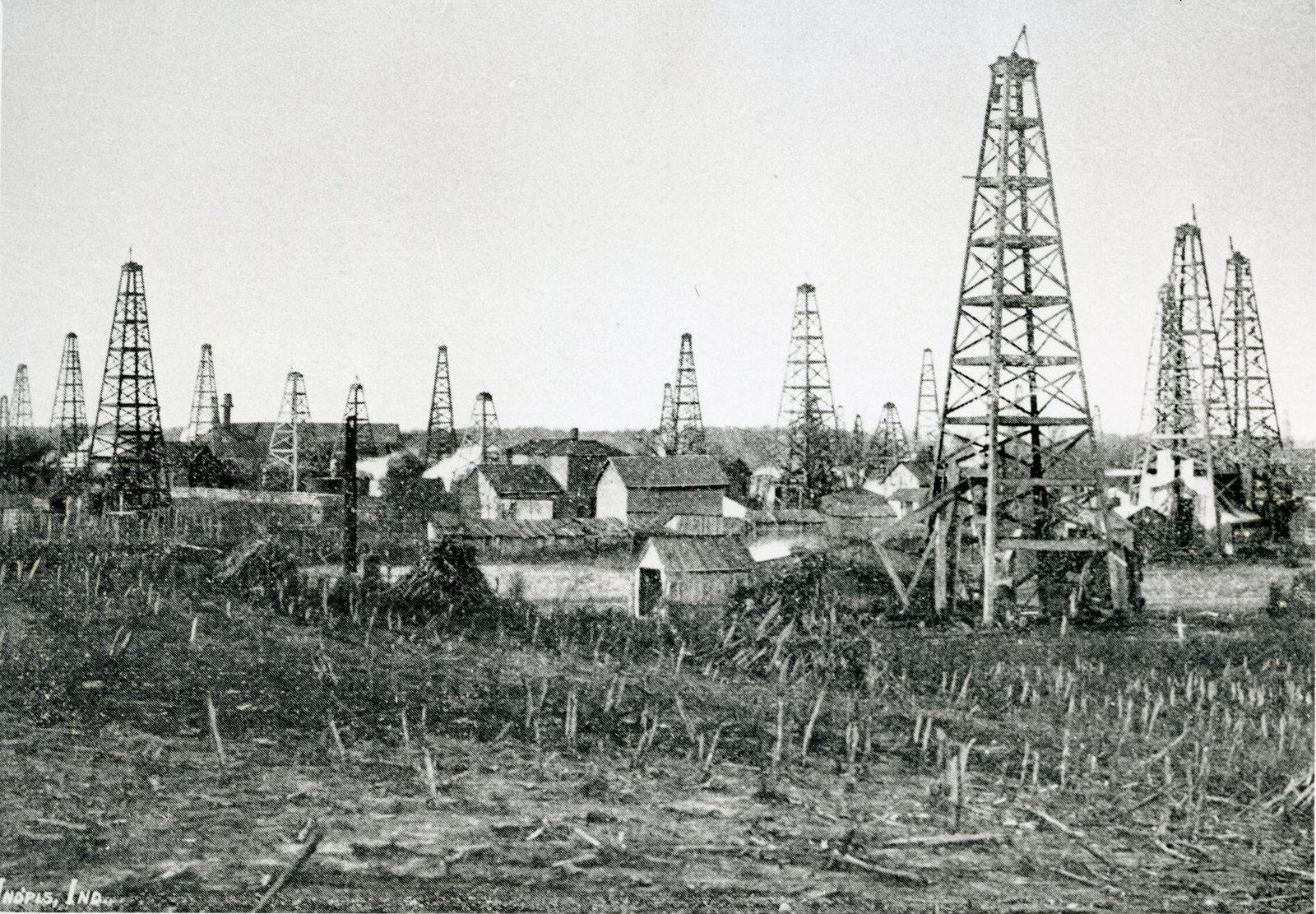
The discovery of natural gas beneath east-central Indiana in 1886 transformed Elwood from a small agricultural and railroad community into one of the region’s important manufacturing centers. Within approximately fifteen years, the city attracted major glass factories, one of America’s largest tin plate mills, furniture manufacturers, machine shops, and dozens of supporting industries.
The gas did more than heat buildings. It provided inexpensive fuel for industrial furnaces, encouraged outside investment, brought skilled workers and their families to Elwood, and supported the construction of new neighborhoods, streets, businesses, and public services.
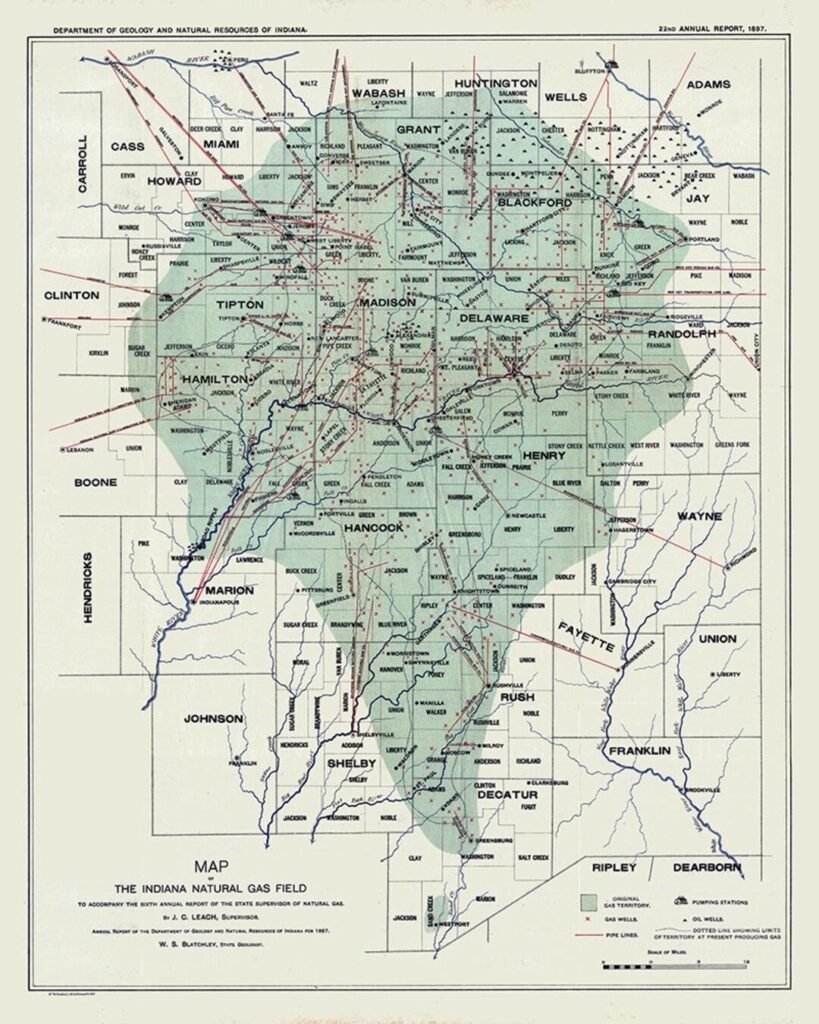
Most importantly, Elwood sat within the Trenton Natural Gas Field, making it a direct beneficiary of one of the most significant natural-resource discoveries in nineteenth-century Indiana.
What the Gas Boom Meant for Elwood
The Trenton Field produced natural gas from ancient limestone deposits lying approximately 900 feet below the surface. Significant commercial discoveries began in Indiana in 1886, and by 1887 communities throughout the region were drilling wells and promoting their access to cheap fuel.
The gas was especially attractive to manufacturers of glass, iron, and steel, whose production required sustained high temperatures. Elwood also benefited from established rail connections, allowing factories to receive raw materials and ship finished products.
Local families, particularly the Callaways and DeHoritys, helped organize land-development efforts to attract manufacturers. These were deliberate attempts to convert a natural resource into lasting industrial growth, rather than simply relying on gas sales.
The Scale of Elwood’s Growth
1890 population
2,284
1900 population
12,950
Ten-year growth
+467%
This represents an increase of 10,666 residents in just one decade. The Indiana state geological report published in 1903 records both census figures, making them preferable to some later local histories that give rounded estimates of 15,000 residents by 1900.
By 1900, Elwood’s manufacturing economy included:
| Indicator | Recorded figure |
|---|---|
| Manufacturing establishments | 135 |
| Manufacturing workers | 2,958 |
| Annual manufactured output | $4,513,128 |
| Residents | 12,950 |
These manufacturing figures come from research published in the Indiana Magazine of History, drawing on the 1900 federal manufacturing census. The value of production is expressed in contemporary 1900 dollars, not inflation-adjusted dollars.
Timeline: How the Gas Boom Transformed Elwood
1886–1887
The Trenton Natural Gas Field is discovered and developed.
Major discoveries beginning near Eaton, Indiana, in 1886 reveal an extensive natural-gas reserve. By 1887, gas discoveries in the Elwood area begin attracting industrial attention. The town’s existing rail connections make it particularly attractive to manufacturers.
1889
Diamond Plate Glass commits to Elwood.
Industrialist Arthur L. Conger decides to build a roughly 14-acre plate-glass factory. The Callaway and DeHority families promote Elwood’s industrial development through land companies.
1890–1891
Two major glass industries establish operations.
Diamond Plate Glass completes its plant by 1891. The George A. Macbeth Lamp Chimney Works builds its Elwood factory and begins producing lamp chimneys. Skilled glass workers arrive from Pennsylvania, bringing specialized manufacturing knowledge and families to the growing city.
April 27, 1891
Elwood votes to incorporate as a city.
Residents vote 377–146 in favor of city incorporation. W. A. DeHority becomes the first mayor. This represents an important civic milestone during the industrial expansion.
1891–1892
American Tin Plate Works is constructed.
Daniel G. Reid and William B. Leeds are associated with establishing the large Elwood mill. Construction begins in 1891, followed by steel-sheet production in June 1892 and tin-plate production in July 1892. The mill becomes a major employer and industrial landmark.
1893–1897
An entire manufacturing economy emerges.
Local histories describe dozens of industries by the early 1890s. A county history published in 1897 identifies 19 prominent factories established after the discovery of natural gas, including glass, furniture, ironworking, boiler manufacturing, brickmaking, and packaging enterprises.
1895–1899
Industrial consolidation begins.
Pittsburgh Plate Glass absorbs Diamond Plate Glass on April 1, 1895. George A. Macbeth’s business becomes part of Macbeth-Evans in 1899. Elwood’s industries are now connected to larger national manufacturing organizations.
1900
Elwood reaches its gas-boom industrial peak.
The federal census records 12,950 residents. Manufacturing statistics record 135 establishments and 2,958 workers. Cheap natural gas has transformed a modest town into a significant industrial city.
1901–1903
The natural-gas supply deteriorates.
Declining well pressure undermines the economic advantage of the factories. Some convert their furnaces to alternative fuels; others reduce operations or close. The major plate-glass operation is reported to have closed in late 1903.
1910
Elwood experiences the aftermath.
The census records approximately 11,028 residents, below its 1900 population. The gas boom has ended, but major facilities and an experienced industrial workforce remain.
Major Elwood Businesses: Establishment Dates
| Business | Earliest documented Elwood start | Product or industry |
|---|---|---|
| Diamond Plate Glass Company | 1889 investment decision; plant completed by 1891 | Large plate-glass sheets |
| George A. Macbeth Lamp Chimney Works | Construction in 1890; production by 1891 | Lamp chimneys, lantern globes and optical glass |
| American Tin Plate Works | Construction 1891; production June–July 1892 | Rolled steel sheets and tin/terne plate |
| W. R. McCloy Glass Factory | Operating by 1897 | Lamp chimneys and glassware |
| Elwood Window Glass Company | Operating by 1897 | Window glass |
| Nivisen & Weiskolp Bottle Works | Recorded by 1897 | Glass/bottling-related manufacturing |
| Elwood Furniture Company | Operating by 1897 | Furniture |
| Elwood Furniture and Planing Mill Company | Operating by 1897 | Furniture and wood products |
| Elwood Boiler and Engine Works | Operating by 1897 | Boilers and engines |
| Superior Radiator Company | Operating by 1897 | Radiators |
| Phil Hamm Boiler Works | Operating by 1897 | Boilers |
| Akron Steam Forge Works | Operating by 1897 | Forged metal products |
| Elwood Iron Works | Operating by 1897 | Ironworking |
| Elwood Box Factory | Operating by 1897 | Boxes and industrial packaging |
| Elwood Brick Company / Starkey Brick Company | Operating by 1897 | Bricks and construction materials |
Three Factories That Most Directly Shaped Elwood
American Tin Plate Works — 1892
The strongest documented connection between the Trenton gas supply and an individual Elwood factory is found in the federal manufacturing census. It identifies natural gas as the fuel used in both the mill’s rolling operations and tin-dipping department.
Construction began in 1891; black plate production began in June 1892; and finished tin and terne plate production followed in July. The operation eventually employed approximately 2,000 people.
George A. Macbeth Glass Works — 1890–1891
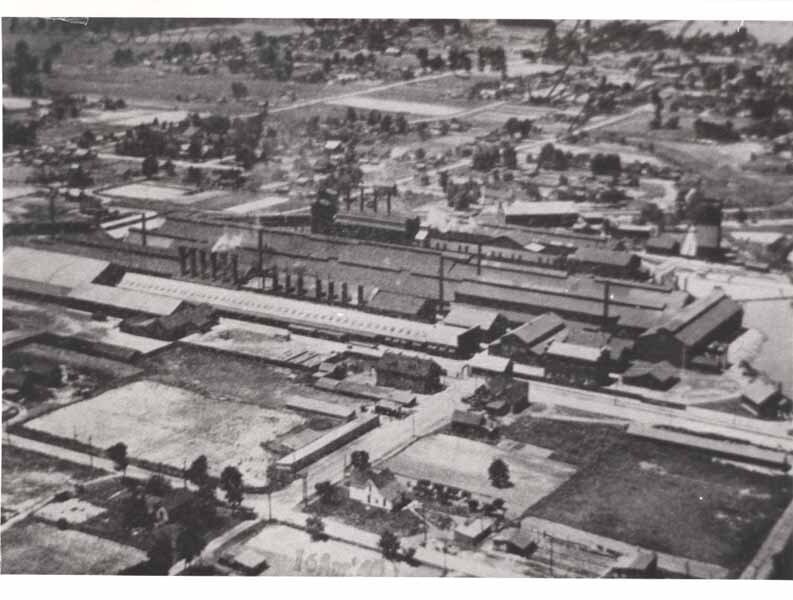
Attracted in 1890, Macbeth’s glass making plant was operating in 1891. Its glass furnaces and specialized labor requirements illustrate why cheap natural gas was such a powerful incentive. A documented account records the arrival of 365 skilled workers from Pittsburgh on August 5, 1891, reflecting the influx of both jobs and population.
The name Macbeth-Evans belongs to a later corporate merger in 1899, rather than the factory’s original opening.
Diamond Plate Glass — 1889–1891
Conger’s decision to construct a 14-acre plate-glass plant in 1889 was an early sign that Elwood was becoming a serious industrial competitor. The factory was completed by 1891 and later became Pittsburgh Plate Glass Works No. 7 after the company’s 1895 consolidation.
Producing large sheets of plate glass required energy-intensive furnaces, making the local fuel supply a defining advantage.
What Happened When the Natural Gas Ran Out?
The Trenton Field’s development contained the seeds of its own decline. Gas was initially treated as virtually inexhaustible. Wells leaked, immense gas flames were maintained as publicity displays, and manufacturers had little incentive to conserve fuel.
By 1898–1901, falling pressure was already forcing changes. Factories that could afford new furnaces or alternative fuel supplies sometimes survived, but others lost the very advantage that had drawn them to Elwood. The Diamond/Pittsburgh plate-glass operation suffered during the downturn, while the tin plate and Macbeth glass industries continued into later decades.