Elwood Airport
From a family’s postwar dream to the world’s first fly-in drive-in, the remarkable story of Elwood’s forgotten aviation landmark.
A Dream Takes Flight — 1946
In the years immediately following World War II, aviation was entering a new era. Thousands of Americans had developed an interest in flying, and inexpensive surplus aircraft, growing flight schools, and small-town airports opened the skies to a generation of civilian pilots. It was during this period of enthusiasm that Elwood residents Don and Georgia Orbaugh established Elwood Airport in 1946. Located south of Elwood near the intersection of State Roads 37 and 13, the modest airfield began as a privately owned operation serving recreational pilots, aircraft owners, and students learning to fly. Don Orbaugh was himself an experienced pilot and flight instructor. What began as his passion for aviation developed into a local institution that would operate for more than 60 years.
Unlike the large municipal airports serving major cities, Elwood Airport was a distinctly rural operation. Its grassy landing strips were surrounded by agricultural land, and the sound of small aircraft engines became a familiar part of life around the property.
The airport eventually occupied approximately 74 acres, with two turf runways arranged in perpendicular directions. Runway 9/27 measured 2,243 feet, while Runway 18/36 measured 2,076 feet. These relatively short, unpaved runways were suitable primarily for smaller general aviation aircraft rather than commercial airliners. The field became a destination for pilots who valued the accessibility and informal atmosphere of small-town flying.
A Tornado Tests the Airport’s Future — 1948
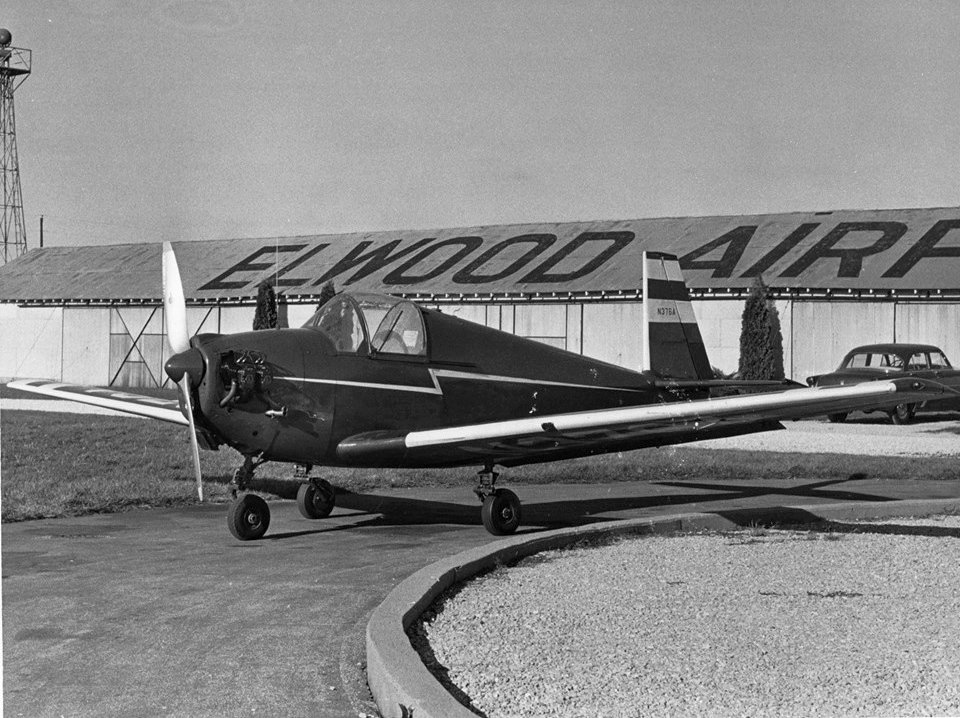
Just two years after its founding, disaster threatened the young airport. In 1948, a tornado struck the property and destroyed its only hangar. The loss was especially devastating for a small business still establishing itself.
Years later, the Orbaughs’ daughter Ann Brewer recalled that local pilots and neighboring farmers came together to help her father rebuild the structure. According to Brewer, her father believed that without their assistance, the airport might not have survived. The rebuilding effort demonstrated how deeply the airfield had already become connected to the surrounding community. The airport was more than a private business; for the men and women who flew there, it was a gathering place built around a common love of aviation.
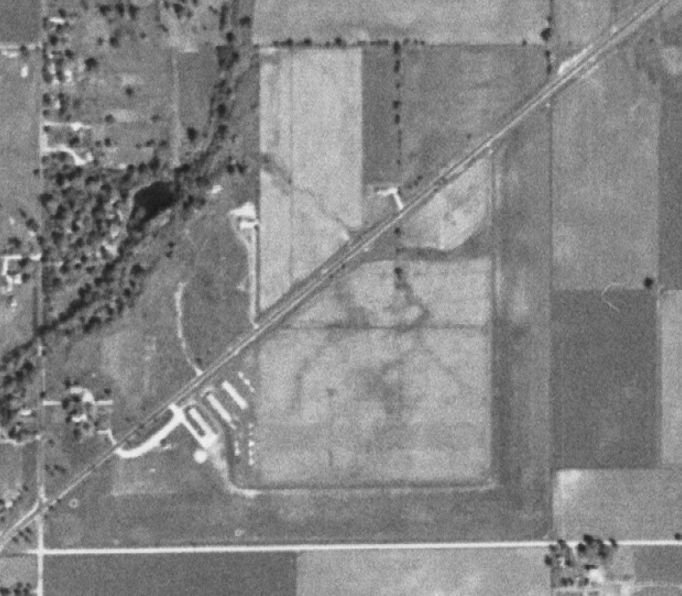
The recovery proved successful. A United States Geological Survey aerial photograph dated September 27, 1952, shows that the airfield had developed considerably. By then, two intersecting grass runways were visible, along with rows of hangars and several parked aircraft.
The World’s First Fly-In Drive-In — 1952–1953
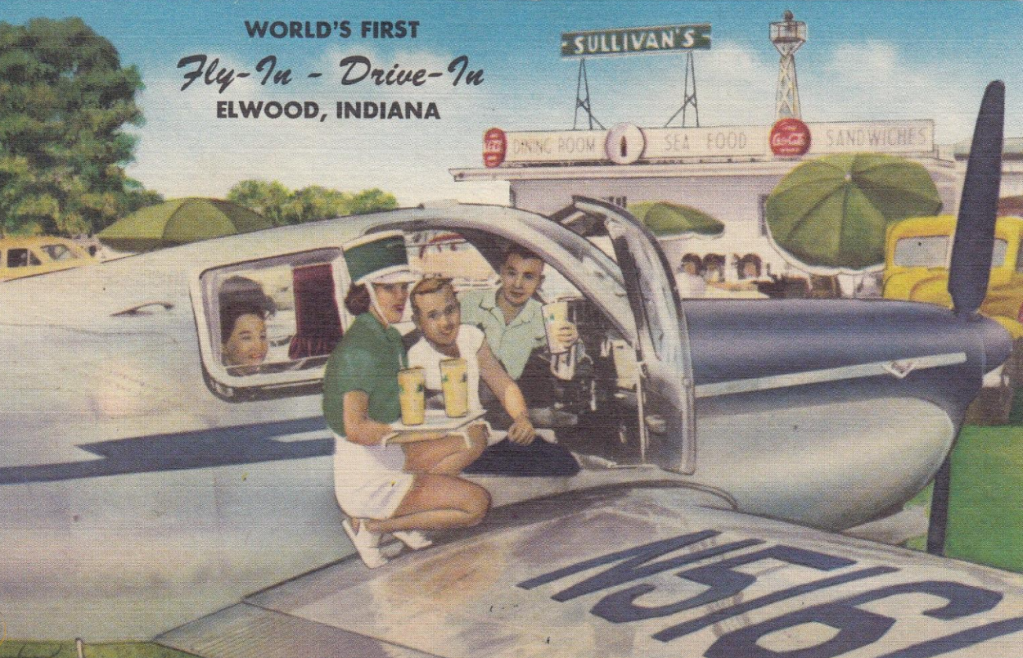
Elwood Airport’s most unusual chapter began in 1952 with the addition of a small ice cream stand. The following year, a dining room was added, and the enterprise developed into one of the most distinctive roadside restaurants in Indiana. Known during its early years as Sullivan’s Airport Restaurant, the establishment combined the growing popularity of automobile drive-ins with the excitement of recreational aviation.
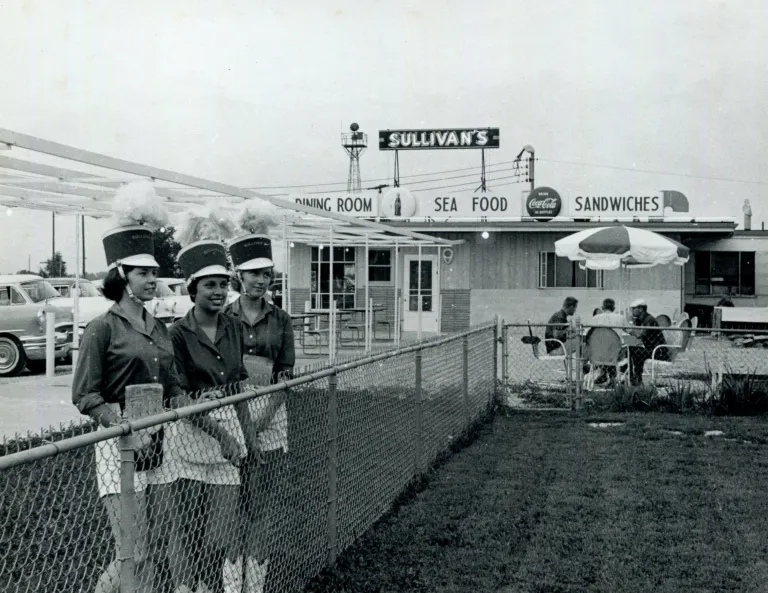
Customers arriving by automobile could order food in the familiar drive-in fashion. But the airport offered something extraordinary: pilots could taxi their airplanes to the restaurant and receive food while seated inside their aircraft. Young waitresses dressed in green uniforms and distinctive matching hats served customers in both cars and airplanes.
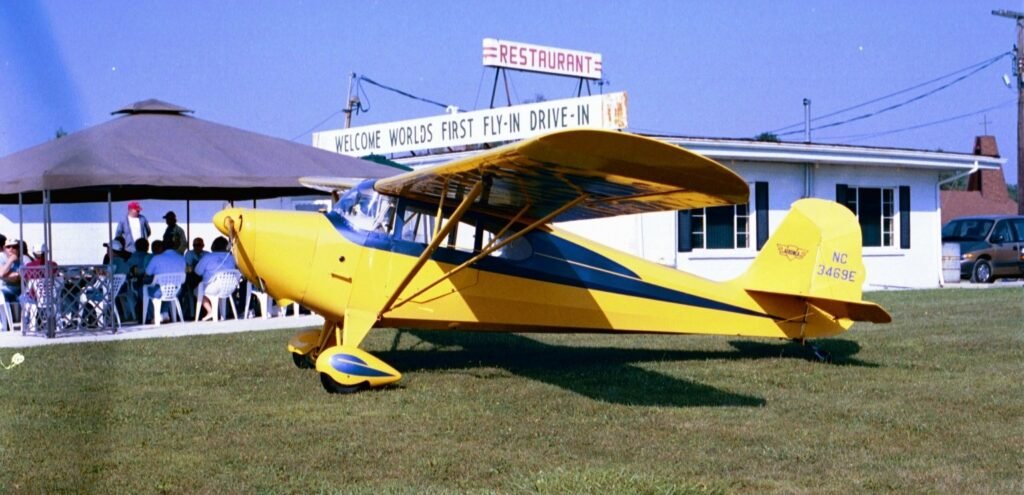
The restaurant promoted itself as the “World’s First Fly-In Drive-In,” a distinction that became inseparable from the airport’s identity. The claim was already appearing in local advertising by 1956. For recreational pilots traveling across Indiana, the restaurant offered an appealing excuse to take to the skies. Aviation enthusiasts have long referred to such excursions as flying for the “$100 hamburger”—a humorous description of the expense of taking an airplane on a relatively short trip simply to enjoy a meal. Elwood became precisely that kind of destination. The restaurant developed a following among pilots and motorists alike, providing the airport with a public identity that extended well beyond flight instruction and aircraft storage.
More Than a Restaurant: Aviation Services in Elwood
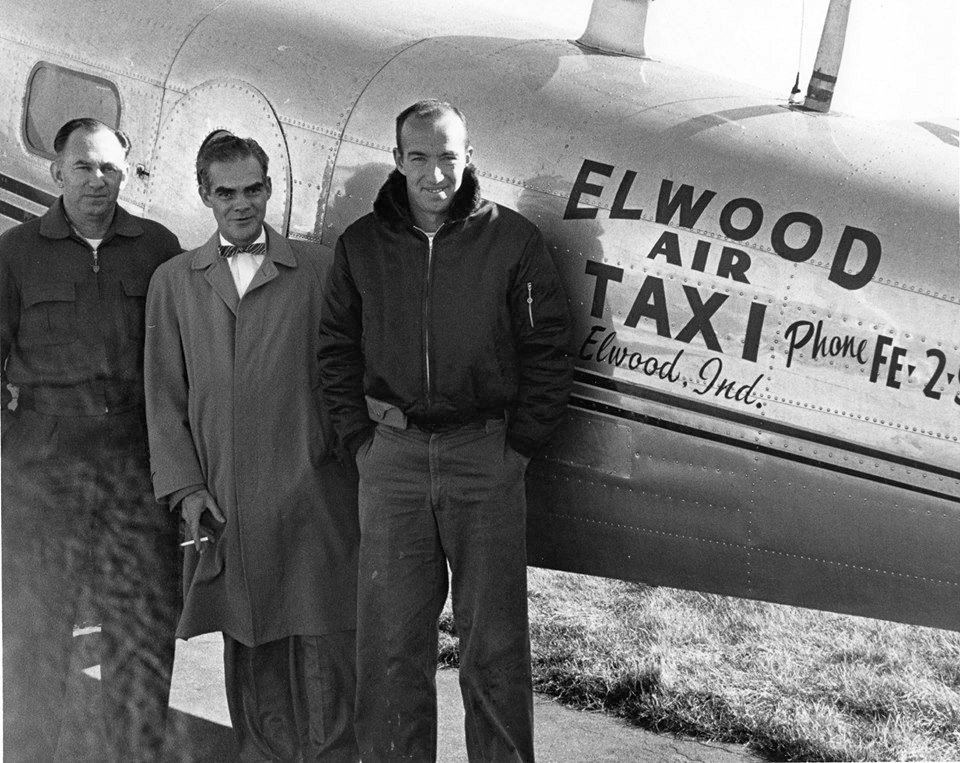
Although the fly-in restaurant became the airport’s best-known attraction, Elwood Airport was also a functioning aviation facility offering services to local and visiting pilots. Flight instruction was an important component of its early operation. Don Orbaugh helped introduce aspiring aviators to the skills and responsibilities of flying. The airport also provided hangar space and aircraft maintenance services. One of the individuals closely associated with its mechanical operation was Jim Howren, a longtime aircraft mechanic remembered by former pilots for his expertise.
A photograph from 1958 shows an aircraft parked near the hangars, a Beechcraft Model 18, also known by its military designation C-45. Painted on that twin-engine aircraft were the words “Elwood Air Taxi.” The photograph provides tangible evidence of an air-taxi operation associated with the airport during the late 1950s. Elwood High School yearbook advertising from 1958 and 1959 also identifies an Elwood Air Taxi Service. While the exact destinations, frequency of flights, and commercial history of the service remain to be established, the surviving evidence demonstrates that the airport’s activities extended beyond recreational flying.
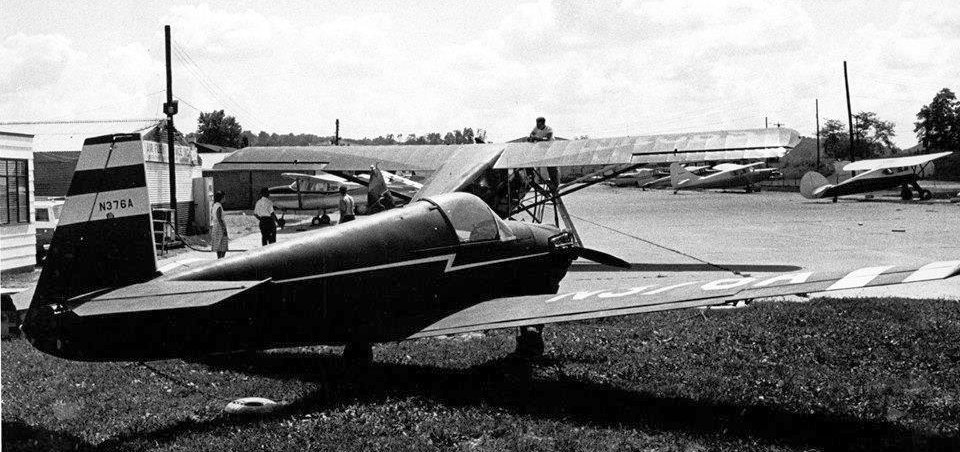
Orbaugh was also remembered as having been an Aeronca aircraft dealer, connecting his operation to one of the popular manufacturers of small American airplanes. For local residents interested in aviation, Elwood Airport offered opportunities to learn, maintain aircraft, and participate in a flying community without traveling to a larger regional airport.
A Family Tradition in the Sky
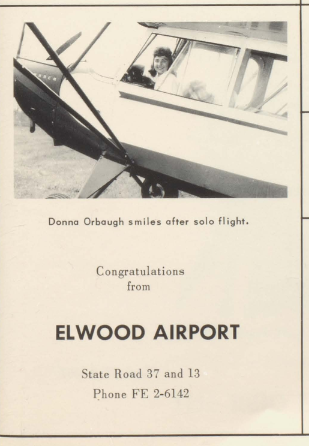
The airport’s identity remained closely connected to the Orbaugh family. An especially personal glimpse into that connection survives in early 1960’s Elwood yearbook material. A photograph carries the caption identifying Donna Orbaugh following her solo flight. It is a small but meaningful piece of local aviation history. The accomplishment of a first solo flight has always represented a major milestone for a student pilot. For the daughter of the man who helped establish Elwood Airport, the moment also illustrates how aviation became part of the family’s everyday life.
Throughout the following decades, the airport continued accommodating small privately owned aircraft, student pilots, and visiting aviators. The restaurant evolved as well. By the late 1960s, it was operating under the name Musick’s Airport Restaurant. A surviving 1969 Frankton High School yearbook advertisement identifies the restaurant at State Roads 13 and 37 and promotes its banquet services. The name reflected a period when Virgil Edgar Musick operated the establishment. Later recollections by his family describe the restaurant as both a workplace and a setting for gatherings and community life.
Over the years, the restaurant attracted customers from across central Indiana, including political figures and state officials. Former restaurant operator Al Swineforth later recalled an unusual visit by Indiana Governor Frank O’Bannon, who reportedly took an impromptu airplane ride while visiting the establishment. Such stories became part of the airport’s character—a place where aviation and ordinary small-town life frequently crossed paths.
The Airport’s Final Years
By the beginning of the twenty-first century, the economics of maintaining a small, privately owned airport had become increasingly challenging. Elwood Airport had never been a major commercial passenger facility. Its continued existence depended on a combination of aviation activity, rental arrangements, agriculture, and the restaurant business. Nevertheless, aircraft were still operating from the field in its final years.
Federal Aviation Administration (FAA) figures for the 12-month period ending August 23, 2005, recorded 2,604 general aviation operations, averaging approximately 217 takeoffs and landings per month. Although modest compared with larger airports, those figures demonstrate that Elwood Airport remained in use well into the 2000’s.
The financial situation, however, had deteriorated. In an August 23, 2008, article published by The Herald Bulletin, airport co-owner Ann Brewer explained that the flying operation was no longer profitable and had been sustained for years by income associated with the restaurant and surrounding agricultural property. Additional recollections collected after the closure suggest that problems involving underground aviation fuel storage and the loss of on-site fuel service may also have contributed to declining traffic. That explanation remains an anecdotal account rather than a fully verified regulatory history.
Ultimately, the financial realities proved too difficult to overcome. On September 1, 2008, Elwood Airport officially closed, ending 62 years of operation. For pilots familiar with the airfield, its closure meant losing another piece of Indiana’s small-airport network. For the Orbaugh family, it marked the end of an aviation enterprise that had begun in the hopeful years following World War II. The restaurant, however, survived.
What Remains of Elwood Airport Today?
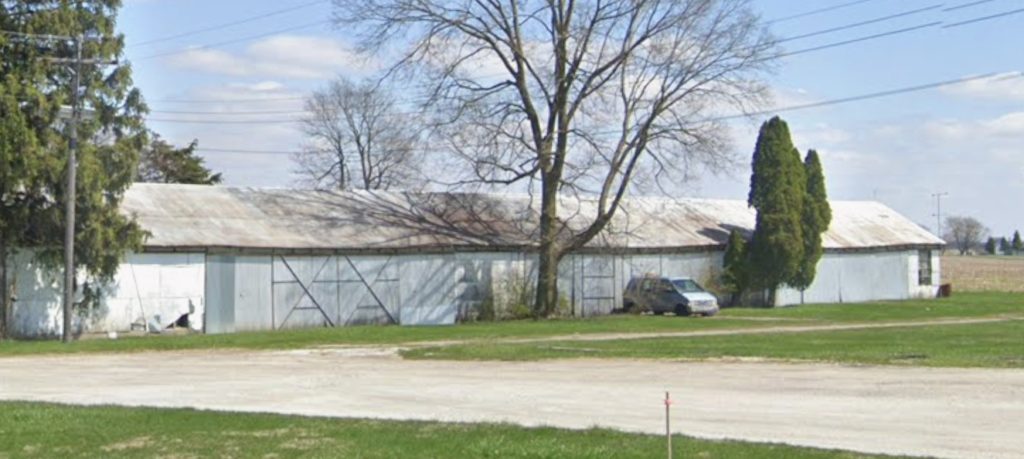
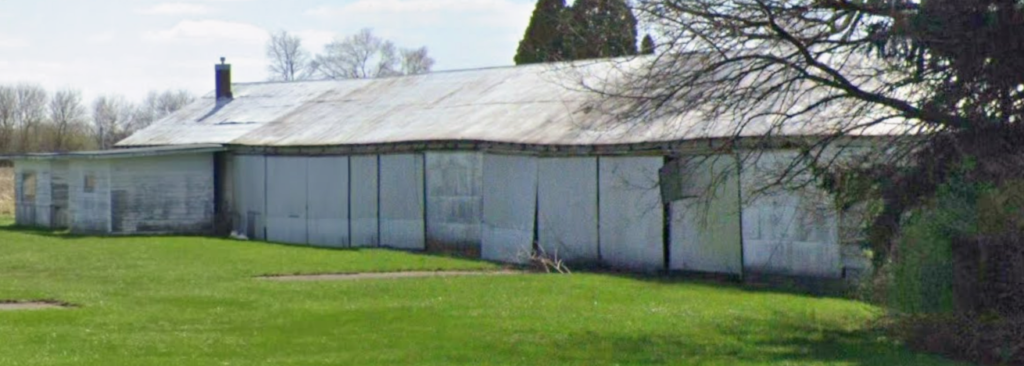
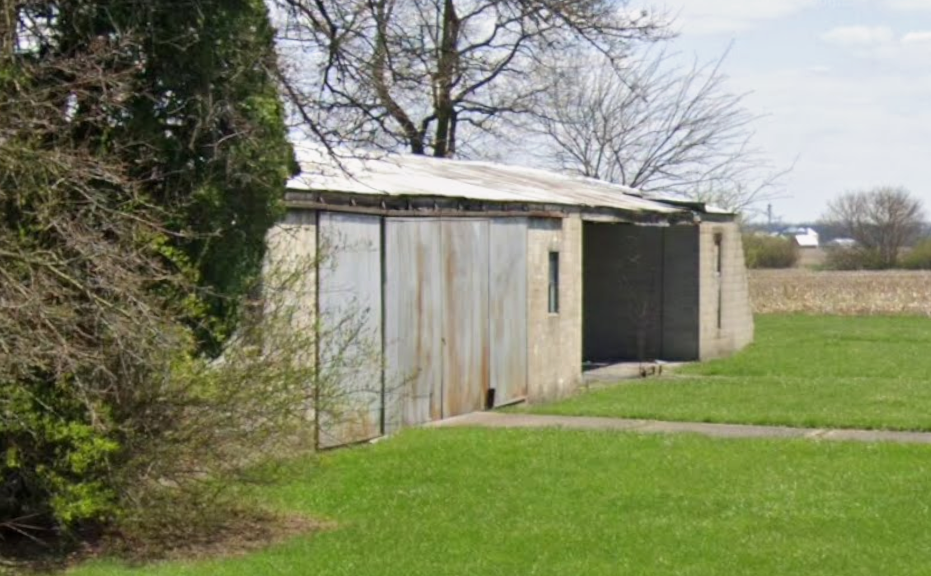
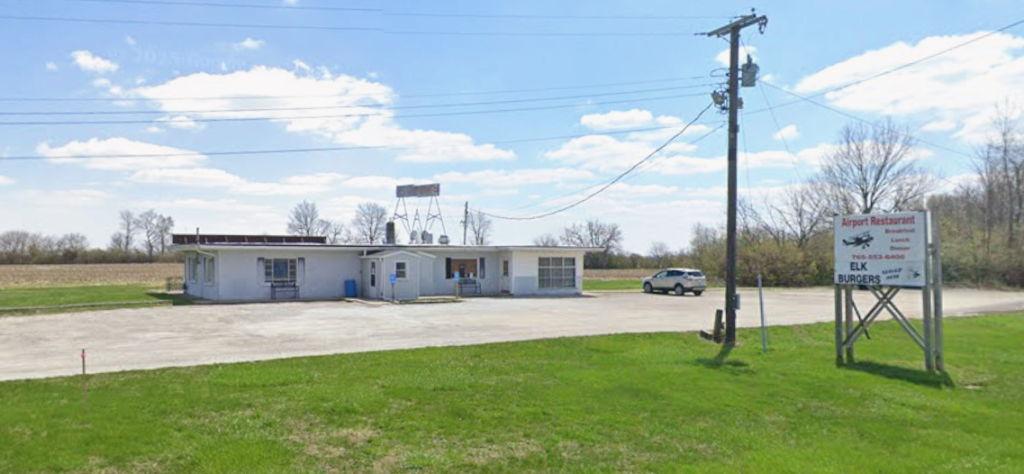
As of 2026, Elwood Airport remains closed. The former grass runways no longer exist. The runway land was converted back to agricultural use and the surviving structures have become reminders of its earlier purpose. The Airport Restaurant is still standing. Two hanger buildings and a mechanical building are currently standing but in poor and rapidly deteriorating condition.
Located at 10130 North State Road 37, the restaurant continued operating long after aircraft stopped landing outside its doors but ceased operation during the summer of 2026. The restaurant had preserved much of its connection to the aviation era. Historical photographs, memorabilia, and the familiar fly-in drive-in identity helped tell the story of a time when customers arrived by air and by automobile. It is currently unknown if the restaurant is closed for good.
For the people who once landed at Elwood, the experience cannot be completely recreated. The sound of an approaching aircraft, the sight of a small plane taxiing toward the building, and the novelty of ordering lunch from an airplane cockpit belong to another era.